Products & small-order examples
Complete product proofs, an explicit nongroup example and the order-12 counterexample. A focused starting point for mathematical review.
- Pattern OR theorem
- Group isotopy
- Explicit FFF12
Combinatorics / Research dossier
Counterreview revision
A Latin square is a table in which every symbol appears once in each row and column.
Which sizes admit such tables when comparing any two distinct rows, columns or symbols gives only even-length cycles?
AI-generated research. Origin & review disclosure.
A two-step cycle, then a three-step counterexample.
| Row / column | 0 | 1 | 2 | 3 | 4 | 5 | 6 | 7 |
|---|---|---|---|---|---|---|---|---|
| 0 | 0 | 1 | 2 | 3 | 4 | 5 | 6 | 7 |
| 1 | 1 | 0 | 3 | 2 | 5 | 4 | 7 | 6 |
| 2 | 2 | 3 | 5 | 4 | 6 | 7 | 0 | 1 |
| 3 | 3 | 2 | 4 | 5 | 7 | 6 | 1 | 0 |
| 4 | 4 | 5 | 6 | 7 | 0 | 1 | 2 | 3 |
| 5 | 5 | 4 | 7 | 6 | 1 | 0 | 3 | 2 |
| 6 | 6 | 7 | 0 | 1 | 2 | 3 | 4 | 5 |
| 7 | 7 | 6 | 1 | 0 | 3 | 2 | 5 | 4 |
(0 1)(2 3)(4 5)(6 7)
Compare the two highlighted rows. Match each symbol in row 0 with the same symbol in row 1, keeping track of the column labels.
0 → 1 → 0
The return takes two steps: an even cycle. The other column labels form three more two-step cycles.
An odd cycle in any row pair makes the row view T; no odd cycle in any row pair makes it F. The column and symbol views are checked separately.
FFF requires all three views to pass. One highlighted pair is only an illustration, not the full check.
python3 -B tools/demo_fff.pyorder=8 latin=True reduced=True| Row / column | 0 | 1 | 2 |
|---|---|---|---|
| 0 | 0 | 1 | 2 |
| 1 | 1 | 2 | 0 |
| 2 | 2 | 0 | 1 |
Apply the same rule to rows 0 and 1 of this smaller table. Symbol 0 sends column 0 to 2; symbol 2 sends 2 to 1; symbol 1 sends 1 back to 0.
0 → 2 → 1 → 0
Three steps is odd, so this row pair already rules out FFF. The complete checker finds an odd cycle in every view: pattern TTT, FFF=False.
python3 -B tools/demo_fff.py examples/order3_nonfff.jsonorder=3 latin=True reduced=TrueThese checks concern individual tables, not the census, the order-10 exclusion or the open order-18 question.
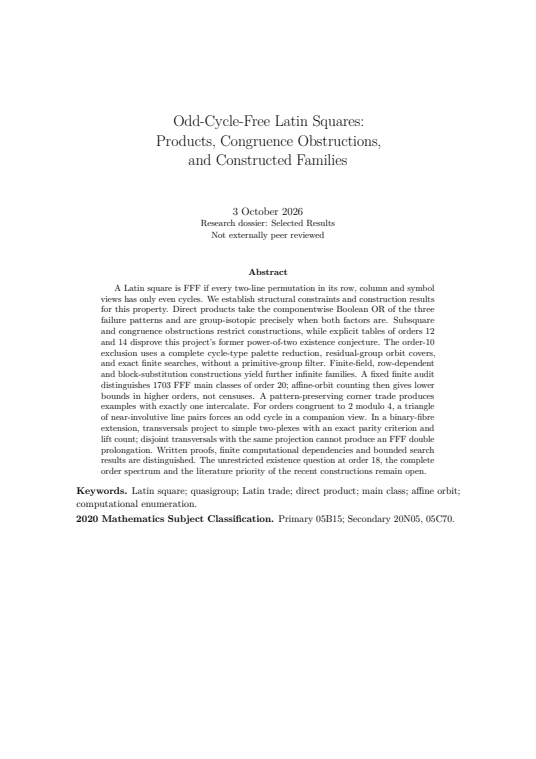
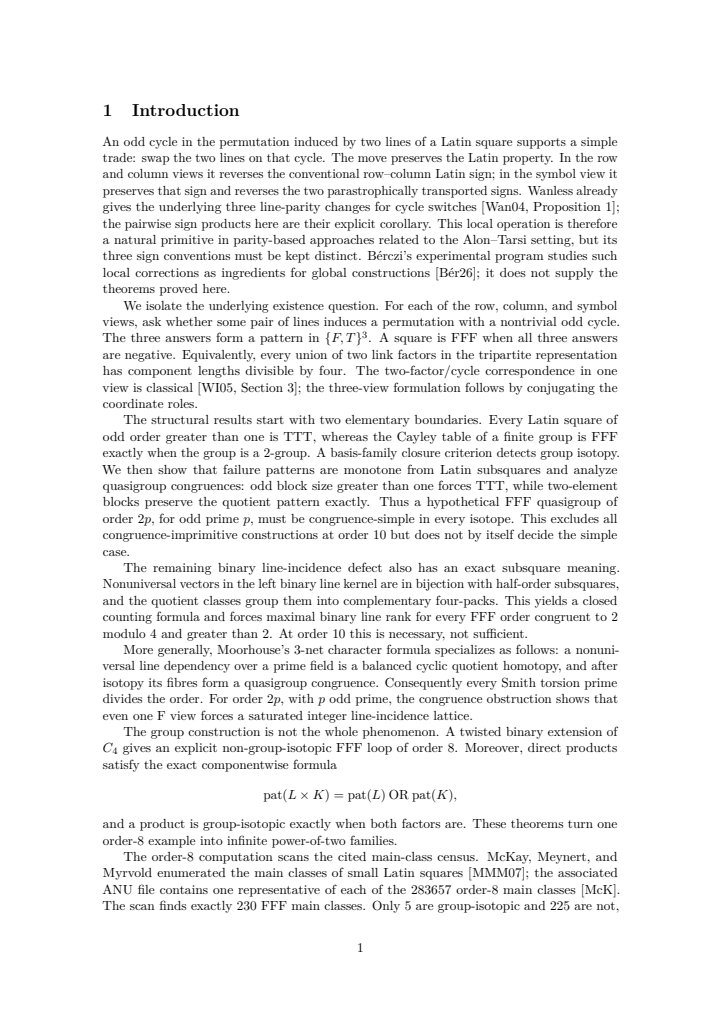
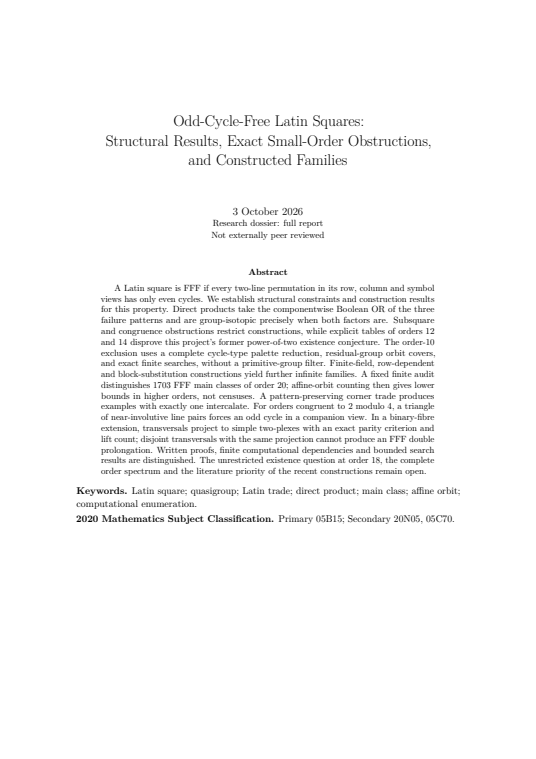
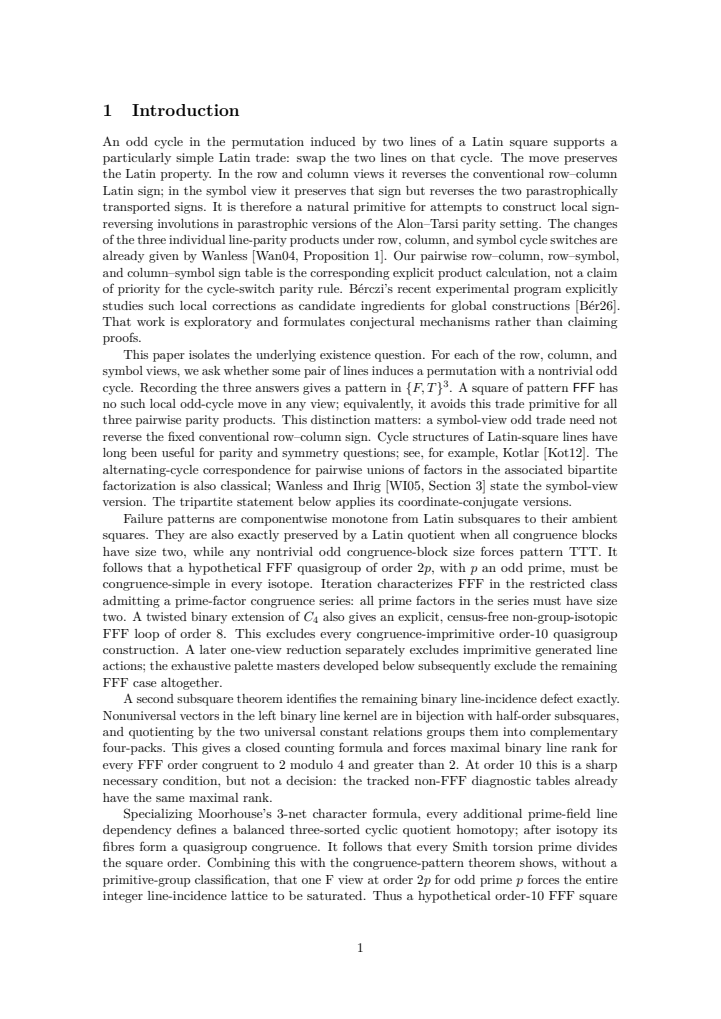
A short entry, selected results, and the full record.
Shared evidence, different reading depth.
Complete product proofs, an explicit nongroup example and the order-12 counterexample. A focused starting point for mathematical review.
The broader theorem collection: finite-field constructions, class lower bounds, cross-view triangles and binary-fibre lifts.
The extended proofs and order-10 reduction, plus a scoped ledger of homogeneous-line, mixed-core and local trade-radius results.
Baseline: , through C280 and the completed binary-first-orbit companion. The only extension is the E9 symmetry theorem included in the internal evidence snapshot at . Other later working results are not included. These editions overlap; they are not independent studies.
The former 44-page Compact is now Selected Results.
Theorem numbers, proof sources & evidenceThe 3 October revision clarifies trade size, prints eight pattern witnesses and improves source checks. It adds no research coverage. The E9 result does not force symmetry or settle order 18. What was checked, and what was not.
Evidence classes in the dossier,
not independent referee endorsements.
Order 12 admits an explicit FFF square, disproving the former power-of-two conjecture C38, an earlier working conjecture of this project. The shipped order-12, 14, 36 and 98 controls are freshly checked in all three views by two scanning methods.
A written exhaustive reduction plus complete exact master searches. This is not a solver-free proof or a proof-assistant certificate; the large search payloads are not included in this export.
For every odd integer m > 1, multiplying m by a sufficiently large power of two gives an order with an FFF square. The theorem supplies an upper bound, not the smallest possible exponent or a decision at order 18.
283,657 main-class representatives; 230 FFF, including 225 not group-isotopic. Completeness of the cited external census remains a dependency.
Fresh checks certify 1,703 represented classes at order 20. Direct rank certificates and the fibred construction give a lower bound of 1,450,956 at order 40. These are not complete censuses.
For orders n = 2 (mod 4), n at least 6, near-type triangles force an odd companion-view cycle. Each near pair has one 4-cycle and otherwise 2-cycles. The order-18 anchor choices give 31 dual-positive or 13 longest-cycle cases, not solved cases; column positivity is not imposed on the latter.
Component parity exactly characterizes transversal lifts and their count for binary-fibre Latin bases. Standard double prolongation along disjoint transversals with the same projected two-plex is non-FFF. Different-projection pairs are outside this obstruction.
One fixed FFF16 base has 72,474,624 labelled first transversals / 18,118,656 free-four representatives, not main classes. Only 18 selected supports / 9,216 labelled firsts have arbitrary-mate exclusions; 138,468 liftable supports remain unexcluded by those packages.
Order 18 remains open, as does the complete order spectrum. Restricted-family exclusions, partial SAT models and timeouts do not settle this existence problem.
The mathematical development, proof text, software and scientific writing arose through ChatGPT/Codex workflows.
The human role was project initiation and provision of time and computing resources, not claimed personal scientific authorship or expert validation.
Full AI-origin disclosureNo accountable scholarly author or independent expert human review of the complete work has been established. Automated checks and public hosting do not establish the correctness or novelty of every statement.
This is a curated export, not the complete working archive. The new portable checker covers finite proof premises, not every local radius or mate payload or fresh historical DRAT replay. Large graph and checkpoint files, third-party census archives and solver environments are not included. There is no persistent data DOI.
Reproducibility and export limitationsRights remain reserved pending a separate licensing decision. Public readability is not an open-source licence or a claim of institutional endorsement.
Rights statementA whole-paper review is not expected. One incorrect cycle, missing assumption or precise earlier reference is useful. Choose a bounded question: